
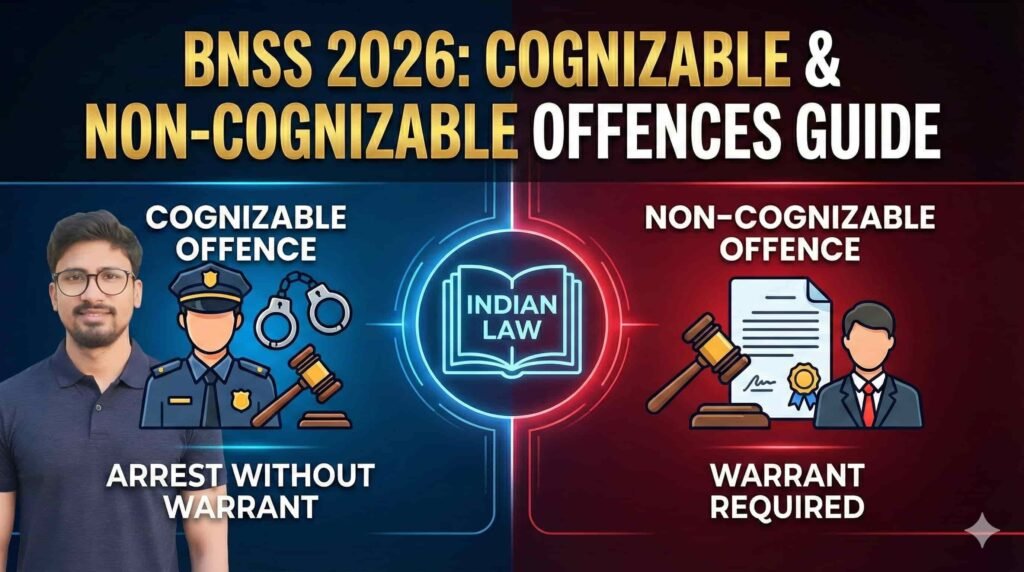
We will gain a deep understanding of cognizable and non-cognizable offences, including clear differences, examples of cases, and all the important aspects related to this. The Bharatiya Nagarik Suraksha Sanhita, 2023 (BNSS) is clearly defined and categorises the rights, powers of the police, and processes for cognizable and non-cognizable offences.
Every citizen should be aware of these offences because, on many occasions, the police misuse their authority and misbehave towards citizens. Therefore, knowing the basics can help you protect yourself without the need for an advocate. So let’s start and learn about these offences.
What are Cognizable and Non-Cognizable Offences?
Indian criminal laws, such as the Bharatiya Nyaya Sanhita (BNS) 2023, categorise offences by the seriousness of the crime.
- Cognizable Offences
- Non-Cognizable Offences
These offences are not only clearly defined in the BNSS but also provide complete details, such as the powers of the police, the procedure for the matter, and other proceedings. BNSS section 2(g) and section 2(o) define the cognizable and non-cognizable offences clearly, so let’s explore these sections of BNSS respectively.
Section 2(g) of BNSS: Cognizable Offence
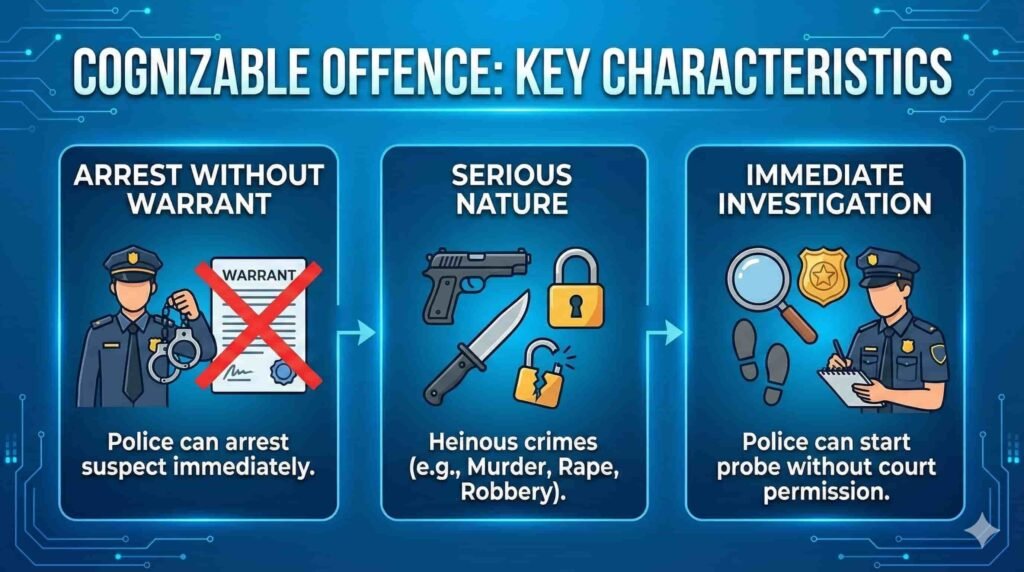
Section 2(g) of BNSS says that if any offences are cognizable means serious in nature, then the police have the authority to file a FIR (First Information Report), investigate the matter, and arrest the accused without the permission of a court or a magistrate.
Section 2(o) of BNSS: Non-Cognizable Offence
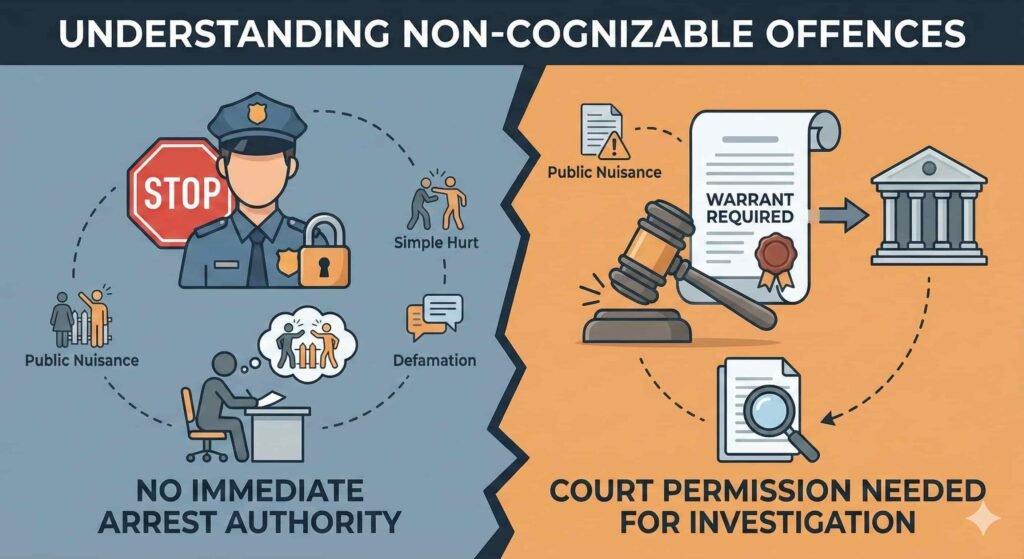
Section 2(o) of BNSS says that if any offences are non-cognizable, then the police have the authority to write an NCR (Non-Cognizable Report), but the police do not have any authority to arrest the accused or begin the investigation without prior permission from a magistrate. These offences are less serious in nature.
What is a Cognizable Offence?
If an offence is to badly harm the individual, society or country, and the prison of more than 3 years, then these offences are considered as cognizable offences. We also list below some examples of these offences so you can check below.
Example of Cognizable Offences and Sections of BNS
Here are some examples of cognizable offences and their sections according to the Bharatiya Nyay Sanhita 2023.
- Attempt to Murder- section 109 BNS
- Kidnapping – Section 137 BNS
- Human Trafficking – Section 139 BNS
- Murder – Section 101 BNS
- Rape – Section 63 BNS
- Dowry Death – Section 80 BNS
- Rioting – Section 189 BNS
Legal Procedure for Cognizable Offences
Now we will understand some key points and facts of cognizable offences.
- Immediate FIR: In the cognizable offence, the victim or witness has the right to file an FIR under section 173 of the BNSS.
- Police Investigation: According to section 175(1) of BNSS, police have the authority to start an immediate investigation without any permission.
- Immediate Arrest: And if the accused is found guilty on the police’s prior investigation, then, as per section 35 of BNSS, the police should immediately arrest the accused without any warrant or approval of a magistrate.
- Legal Proceedings: Then, if the accused is found guilty on the detailed investigation of the police, the police file the chargesheet against the accused in the session court, and then the case will come in front of the court.
Judicial Scrutiny
After filing the chargesheet in the court, the matter will come in front of the judge, and then the trial will start in the court.
Public and Media Attention
Cognizable offences are gaining more public and media attention than non-cognizable offences because these are the serious, threatening and harmful to the individual or society.
What is a Non-Cognizable Offence?
An offence which does not badly harm the individual or is not threatening to the entire society or country that are non-cognizable offence. According to section 2(o) of BNSS, the police do not have the authority to immediately arrest the accused without any warrant or prior permission from the magistrate. Section 2(o) of BNSS also says that in which the prion of less than 3 years that are non-congnizable offence.
Example of Non-Cognizable Offences and Sections of BNS
You can see some examples of non-congnizable offences and sections of BNS.
- Cheating- Section 318 BNS
- Simple Hurt – section 117 BNS
- Defamation-section 356 BNS
- Public Nuisance – section 270 BNS
- Other Similar Crimes
Legal Procedures and Police Powers on Non-Cognizable Offences
Let’s discuss some legal procedures and police powers on Non-Cognizable offences.
- Complaint to Magistrate: In non-cognizable offences, the victim also has the right to directly approach the magistrate under section 210 of the BNSS.
- Magistrate Permission for Investigation: In these types of offences, the police have to take permission under section 178(1) of BNSS from the magistrate to start an investigation.
- Arrest Only with a Warrant: Police can’t directly arrest the accused in these types of offences; police will require a warrant from the court or magistrate for arrest.
- Case Hearing: The case will be heard in the session court of the district.
Public and Media Attention
Non-cognizable offences generally gain less public and media attention in comparison to the cognizable offences because these are the general crimes that often happen.
Difference Between Cognizable and Non-Cognizable Offences
Let’s explore some major differences between the cognizable and non-cognizable offences.
| Facts | Cognizable Offence | Non-Cognizable Offence |
| Definition | Check section 2(g) of BNSS or the above paragraph of this post | Check section 2(o) of BNSS or the above paragraph of this post |
| Nature | Can be registered without the Magistrate’s permission | Less serious |
| FIR (First Information Report) | Immediately register FIR without any prior approval of the magistrate | Police can’t register an FIR without the permission of a magistrate |
| NCR (Non-Cognizable Report) | FIR will register instead of NCR | Police can’t register an FIR without the permission of a magistrate |
| Arrest | Police need a warrant | Need a warrant for arrest |
| Police can’t register an FIR without the permission of a magistrate | Can begin immediately | Needs Magistrate’s approval |
| Police Investigation | Sessions Court | Magistrate Court |
| Examples | Murder, Rape, Kidnapping, Theft, Robbery, and other serious crimes | Defamation, Public Nuisance, Normal Hurt |
| Punishment | More than 3 years | Less than 3 years |
| Bail | Generally Non-Bailable | Instant Bailable |
Conclusion
So, I hope you will know all the things about the Cognizable and Non-Cognizable Offences by the BNSS. We will try to explore all areas of these offences from the police station to the courtroom. If you want to update with the laws or rights, you can bookmark our website site mukdma.
FAQs
What is the difference between cognizable and non-cognizable offences?
The major difference between cognizable and non-cognizable offences is that in a cognizable offence police can immediately register an FIR, investigate the matter and arrest the accused without any permission from the court or magistrate, but in a non-cognizable offence, the police can’t register an FIR, investigate the matter or arrest the accused without a warrant or permission from the court.
What is an example of a non-cognizable offence?
The examples of non-cognizable offences are such as defamation, general injury, public nuisance, etc.
What is a cognizable offence?
If an offence is to badly harm the individual, society or country, and the prison of more than 3 years, then these offences are considered as cognizable offences.

Hi, I’m Yogesh Mishra. I’m a law student and experienced legal SEO content writer. I have more than 4 years of experience in SEO content writing, web design and dev, GMB optimization, and other digital marketing works because I also run my digital marketing agency. So I’m also available for your online projects or legal writing.